DEVELOPMENT NOTE
Development Note: Thoughts on Tuning Shooting Game Difficulty
Difficulty and unfairness are not the same. This note sets out the criteria used when tuning enemy placement, warnings, hitboxes, and gradual scaling in VOID STRIKER.
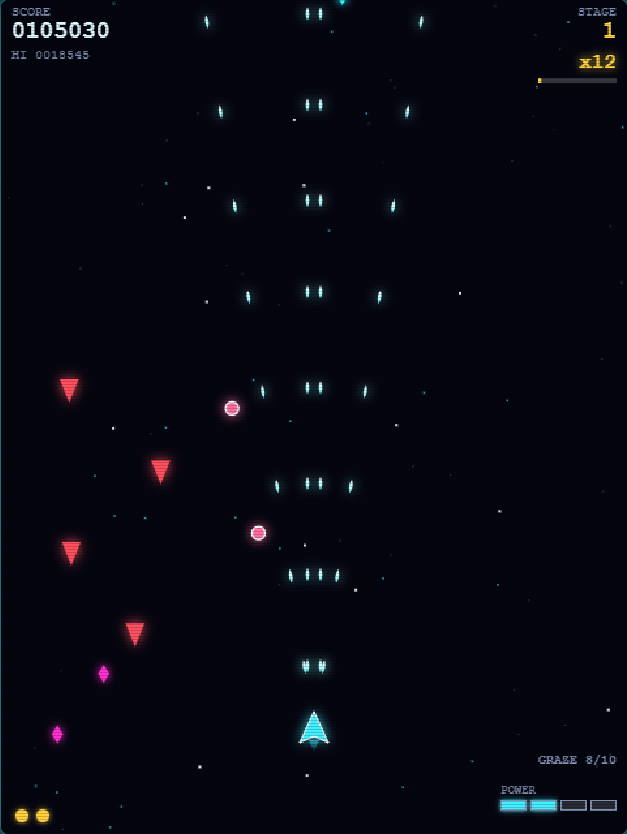
A shooting game's difficulty is not determined by enemy count and bullet speed alone. The same bullet pattern feels very different depending on whether danger can be read before firing, the player craft's hitbox can be understood, and the next improvement is visible after a failure. In VOID STRIKER, the goal was for a player to be able to explain “why that hit me” at the moment of impact.
Four questions for checking a “fair death”
When a hit occurs during testing, instead of recording it simply as difficult, separate it into these four points.
- Could the direction of the danger be recognized before firing, or while it was still far enough away?
- After it became visible, was there still enough time for the controls to evade it?
- Did overlapping colors from enemy bullets, the background, effects, and the player craft make them difficult to distinguish?
- On retrying the same situation, was it clear that a different action could avoid the hit?
The fourth point is particularly important. Even if a pattern can be avoided, a layout whose answer can only be found by chance does not support learning. If a safe area can be predicted from the firing position or the preceding movement, a failure becomes information for changing the next input. The aim is not to lower the difficulty, but to provide the information needed for a decision in advance.
Communicating warnings through shape and sound as well as time
Fast attacks such as sniper shots lose their character if the bullets are merely slowed down. Instead, a pre-fire sight line, a pause in enemy movement, or a color change can show the dangerous line in advance. In VOID STRIKER, the warning time for a sniper shot is fixed at 0.6 seconds and is not shortened in later stages. Standard bullets become faster and more frequent as stages advance, but the basic time needed to read a warning remains.
Too many warnings fill the screen with another kind of information, so strong attacks receive clearer warnings while standard bullets communicate through their paths. Sound effects follow the same principle. Rather than giving everything a loud alert, reserve them for moments that require a decision even during an instant when the player is not looking at the screen, such as a boss transition or special attack.
A smaller hitbox should still be clear
If the entire player craft image is used as its hitbox, a bullet grazing a wingtip causes damage and diminishes the pleasure of moving through dense patterns. VOID STRIKER treats entities as circles and detects collisions by position and radius. The important point is not only to make the radius small, but also to ensure that the player does not lose sight of the reference point. Fine positioning during slow movement also provides the control needed to pass through narrow gaps.
During tuning, the question is not whether bullets and the craft appear to overlap in a still image, but whether the player can tell where to move the center at the actual speed. If strong glow or screen shake obscures the center, reduce the effect's opacity or duration. Reading the situation immediately before a hit takes priority over making the hit effect elaborate.
Do not raise several difficulty axes at once
If enemy HP, bullet speed, firing frequency, and spawn count all rise sharply at once, it becomes unclear which change caused a blockage. VOID STRIKER caps effective stage scaling at stage 8, limiting processing load and unavoidable situations even during endless progression. Standard enemies change gradually in HP, bullet speed, firing interval, and spawn count by stage, while the number present at once is capped at 48.
In practice, first fix stage 1 as a baseline, then test one item at a time in this order.
- Change only enemy placement and check whether a safe destination remains on the screen.
- Change bullet speed and check the balance between bullets evaded on sight and bullets that require prediction.
- Change the firing interval and check whether there is time to return to position after evading.
- Finally, adjust HP and check whether the decision to destroy dangerous enemies first remains meaningful.
If raising a value reduces the player's available choices to one, lower another axis. The purpose of difficulty is not to rush inputs, but to ask the player to choose priorities among several dangers.
Bombs and grazing as difficulty controls
A bomb is not merely a substitute for an extra life. When overlapping bullet patterns remove the safe area, it lets the player reset the layout. If players are often hit while still holding bombs, review when danger can be recognized and how the control is explained, rather than changing the bomb's effect. Players need enough information to press it when the escape route begins to close, not only just before impact.
Grazing, by contrast, rewards the choice to approach danger. Counting enemy bullets that pass near the player craft and tying them to score allows safe play aimed only at clearing the game and risky play aimed at a high score to coexist under the same rules. Stage results show kills, grazes, no-miss performance, and other measures separately, so players can choose what to improve next.
Looking at points of failure rather than averages in play records
Clear rate alone does not reveal the cause. During development checks, briefly record the time of impact, position on the screen, bombs remaining, and the combination of enemies that appeared immediately before. If four of five hits occur at the lower right of the screen, for example, check whether an enemy placement that draws the player right overlaps the next wave before reducing all bullet speeds.
Also separate first-time play, play after learning the controls, and score-focused play. An attack that cannot be read the first time but can be avoided on the second attempt works as a learning element. If choices disappear in the same place after repeated attempts, revise the warning, placement, or cap. Continuing this separation brings the game closer to difficulty whose failures can be understood, rather than simply making it easier.
Related links
About this article
Written by rin0420, the developer of the games and tools published on this site. The screenshots and figures shown here were captured from the live versions by using them directly.
Published July 14, 2026 / Last updated July 25, 2026 (screenshots added)